Hospitality
Why the hotels we never forget start with the memory, not the masterplan.
Published for an event at OXO, Bali - 12 August 2026
Why do we remember some hotels for the rest of our lives and forget others the moment we check out?
Think about it from the guest's side. Someone flies to Bali from Europe. Sixteen hours in the air. And they might have three weeks of holiday per year. So the ten days they spend in a hotel are not a booking. They are a third of that person's entire year of freedom. The scarcest thing they own.
They're not buying a room. Nobody flies sixteen hours for a room.
They're buying what they take home. And a year later, they won't remember the size of the room or the marble in the bathroom. They'll remember how the place made them feel.
And this is the core of everything I have come to believe about hospitality: hotels are not in the accommodation business. We are in the memory business.
Here's my confession. I was trained as an architect at a school shaped by parametric design, the world of Zaha Hadid, of flowing forms, of buildings that look spectacular from a drone. I was trained, quite literally, to design the most photogenic architecture on earth. Today I work as a developer and advisor. And that shift changed the way I think about what we should design in the first place.
Nobody, in all those years, taught me to design something that would be remembered. Not remembered as an image but remembered as a moment. As an experience someone carries home.
And photogenic and memorable, I've learned, are not the same thing. Sometimes they're opposites.
Here's the strange part: psychology has shown that we don't remember experiences evenly. The most intense moments, and often the ending, have a disproportionate influence on what survives in memory. Which means memory isn't luck. Memory can be designed.
And if memory is the real product, then it's one of the most valuable things a developer can design for.
These are the five decisions that shape it. I learned the first one not in a book, but standing in a lobby in Sri Lanka, at sunset.
1. Design the Peak
Heritance Ahungalla, Sri Lanka - Geoffrey Bawa, 1981
January 2020. I was in Sri Lanka, following the footsteps of an architect who had been dead for seventeen years: Geoffrey Bawa, the father of Tropical Modernism.
And here's the irony. At that exact time, back home, I was working on a hotel development in Frankfurt. A big international brand. A good, professional project, designed the way most hotels are designed: program first, floor plan, room count, spreadsheet. Forwards.
And in my holidays, I was chasing a man who had designed hotels the other way around.
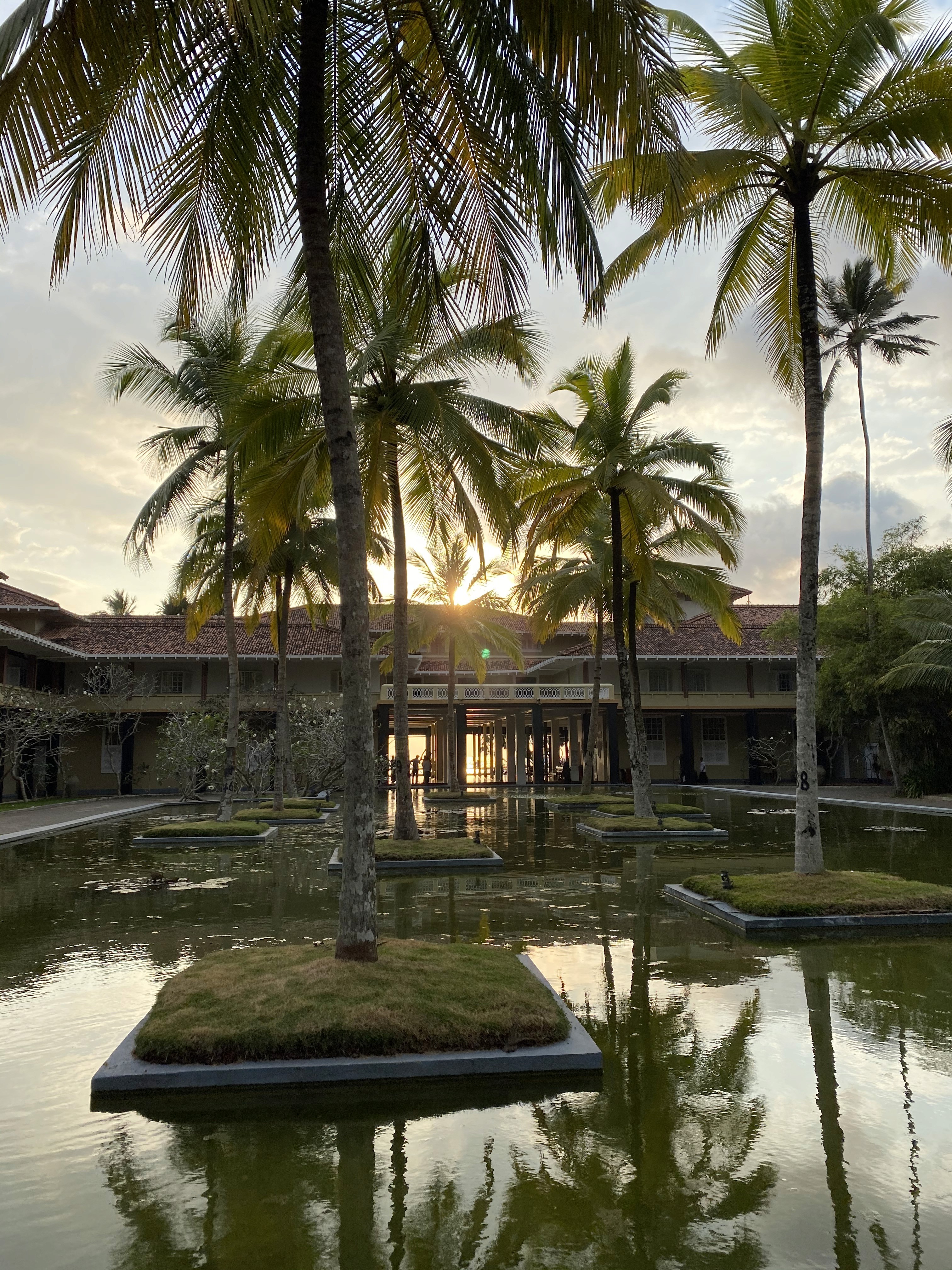
One evening I came back to my hotel, the Heritance Ahungalla, which Bawa built in 1981. I'd been out all day at Lunuganga, his garden estate. I drove in through the entrance, walked toward the lobby and stopped.
In front of me: a pond. Beyond the pond: the open lobby. Beyond the lobby: the pool. Beyond the pool: the ocean. And the sun was setting. Its light passing straight through the building, touching every surface of water on its way to me.
Everything on one level. Pond - foyer - pool - beach - horizon. One single line, drawn forty years before I stood on it.
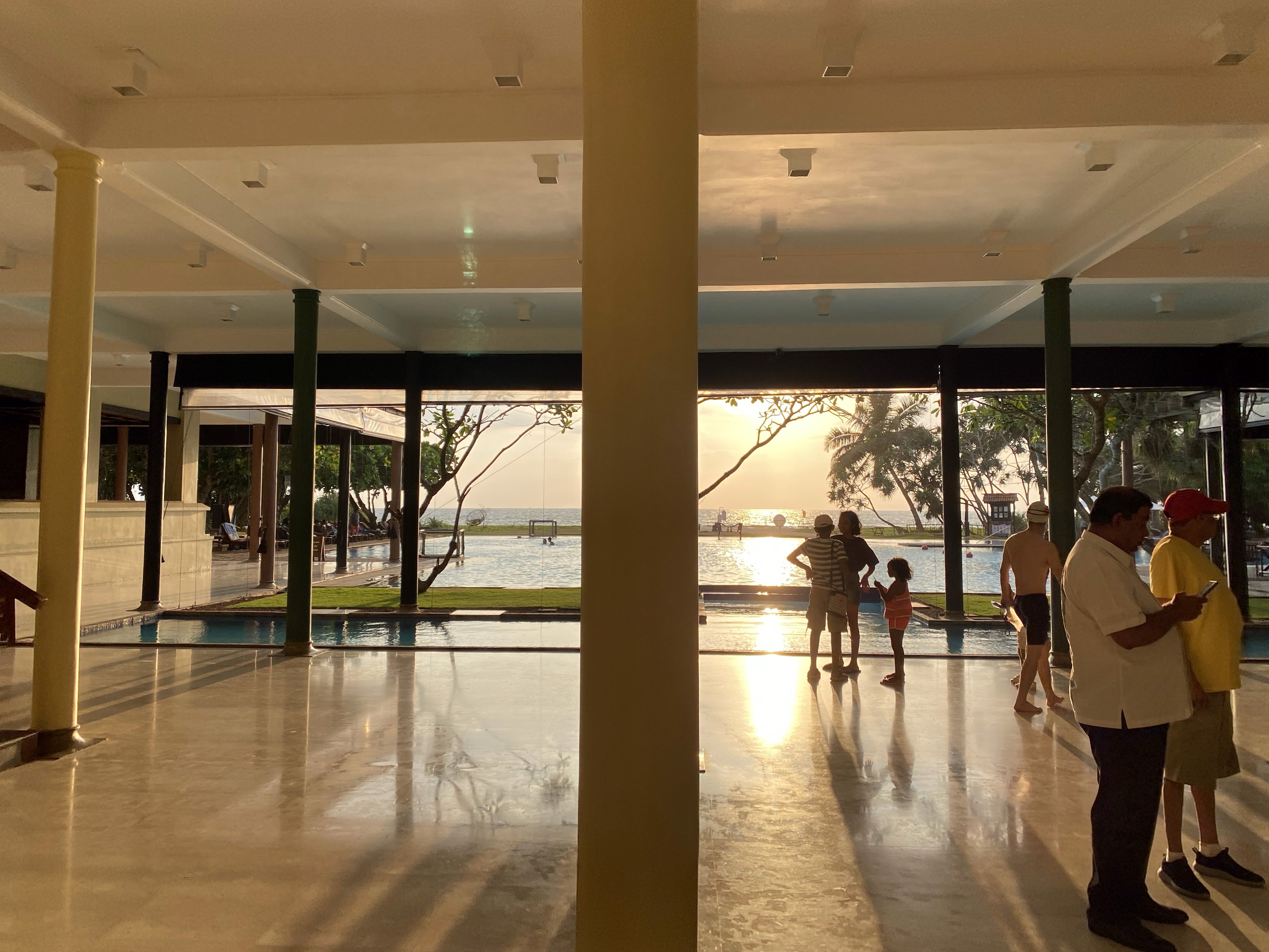
I took this photo that evening. But I didn't post it that night. I posted it in May 2020, in the middle of lockdown, when nobody could travel and every hotel on this planet was empty. And what did I have left of this hotel? Not the room. Not the pool. The memory. That's what I posted. That's what survived when everything else about travel had stopped.
The caption I wrote was: "At the same level. Pond - foyer - pool - beach." It took me a few more years to understand what I had written that evening. Because soon after, I was back at my desk -> designing forwards.
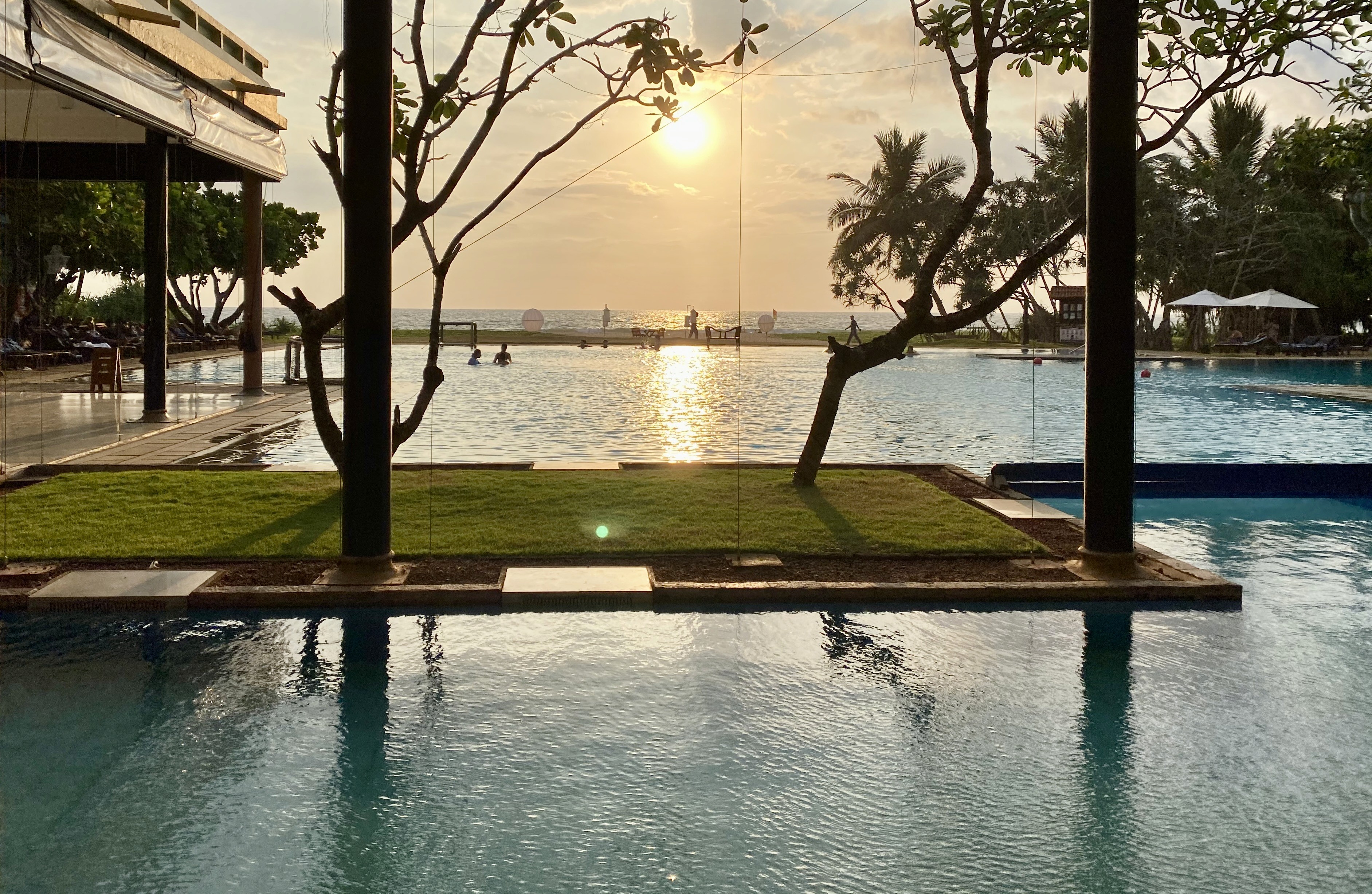
I have to be honest about this hotel. The interiors are dated. The furniture has been replaced several times since 1981. If you judge it the way I was trained to judge, by the photographs, it lost decades ago.
But the axis works exactly as it did on opening day. Bawa designed one moment, one peak, so strong that it dominates everything a guest remembers about this hotel.
And here is the developer in me talking: over forty years, those interiors have been replaced and written off more than once. The one investment that never needed replacing is the spatial idea.
The interiors depreciated. The memory appreciated.
That is the first decision: design the peak.
2. Design the Sequence
Heritance Kandalama, Sri Lanka - Geoffrey Bawa
On the same trip, I drove inland, to the hotel many consider Bawa's masterpiece: Kandalama. Built into a cliff above an ancient reservoir, in the early nineties.
The journey there tells you everything. The last stretch is a simple road. When I drove it, parts weren't even paved. Monkeys on the road. No gate, no fountain, no golf-cart lobby. For a while you think: this can't be right.
And then you arrive and the hotel almost isn't there.
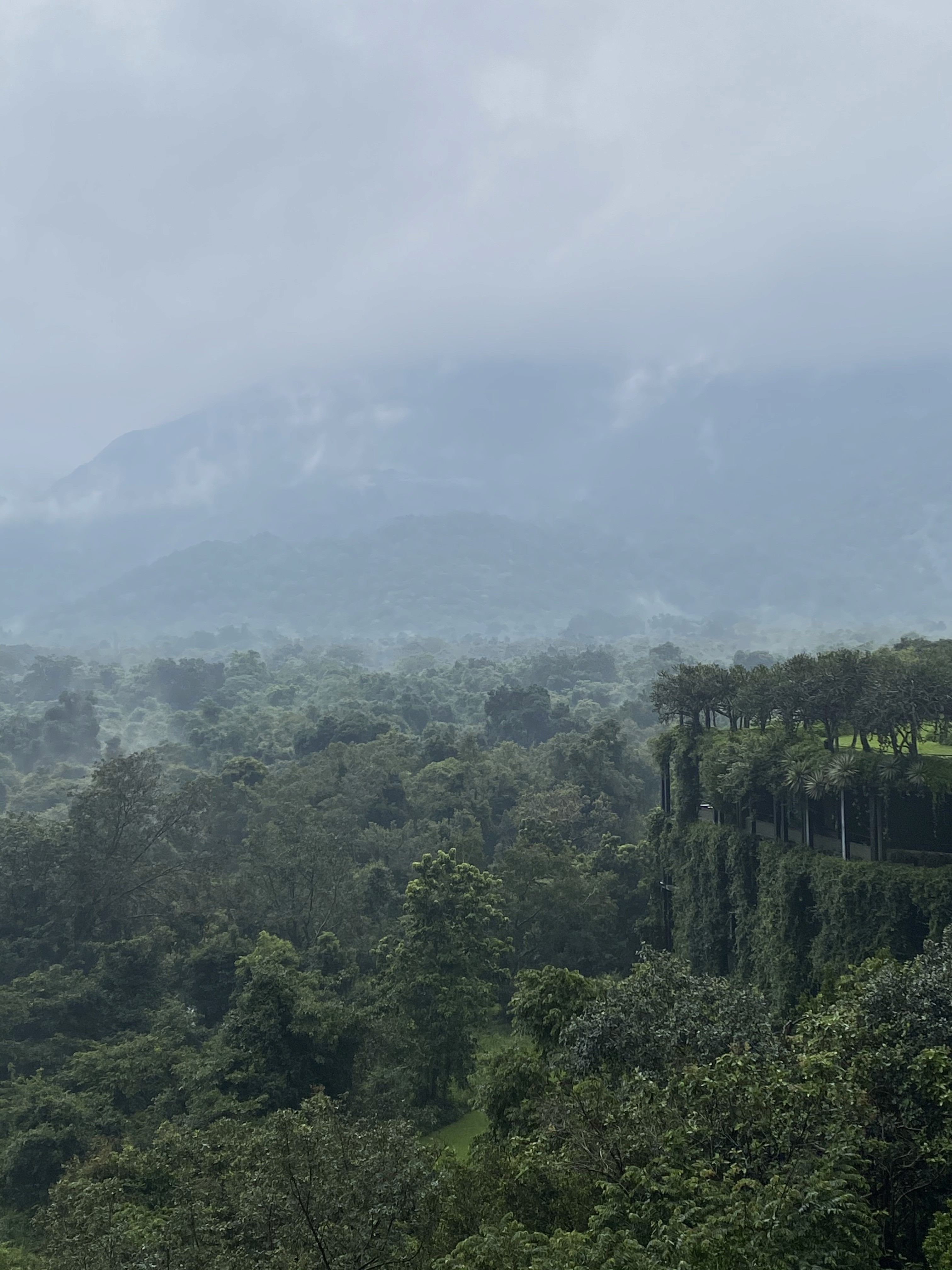
One kilometre of building, seven floors, following the line of the cliff. And you can barely see it. The facade is completely overgrown. The building stands on pillars so that water and wildlife pass underneath it. Monkeys climb across it like it's part of the forest. Rainwater is collected and channelled back into the lake.
Inside, the cliff itself comes through the walls. There is raw rock in the lobby, Bawa didn't blast it away. He built around it. Water runs out of it.
And my favourite detail: one of the pools. When they built it, there was a natural rock formation in the way. The obvious move, the move many architects are trained to make, is: remove the rock, pour the perfect rectangle. They left the rock in the pool.
The rock was there first. The building is the guest.
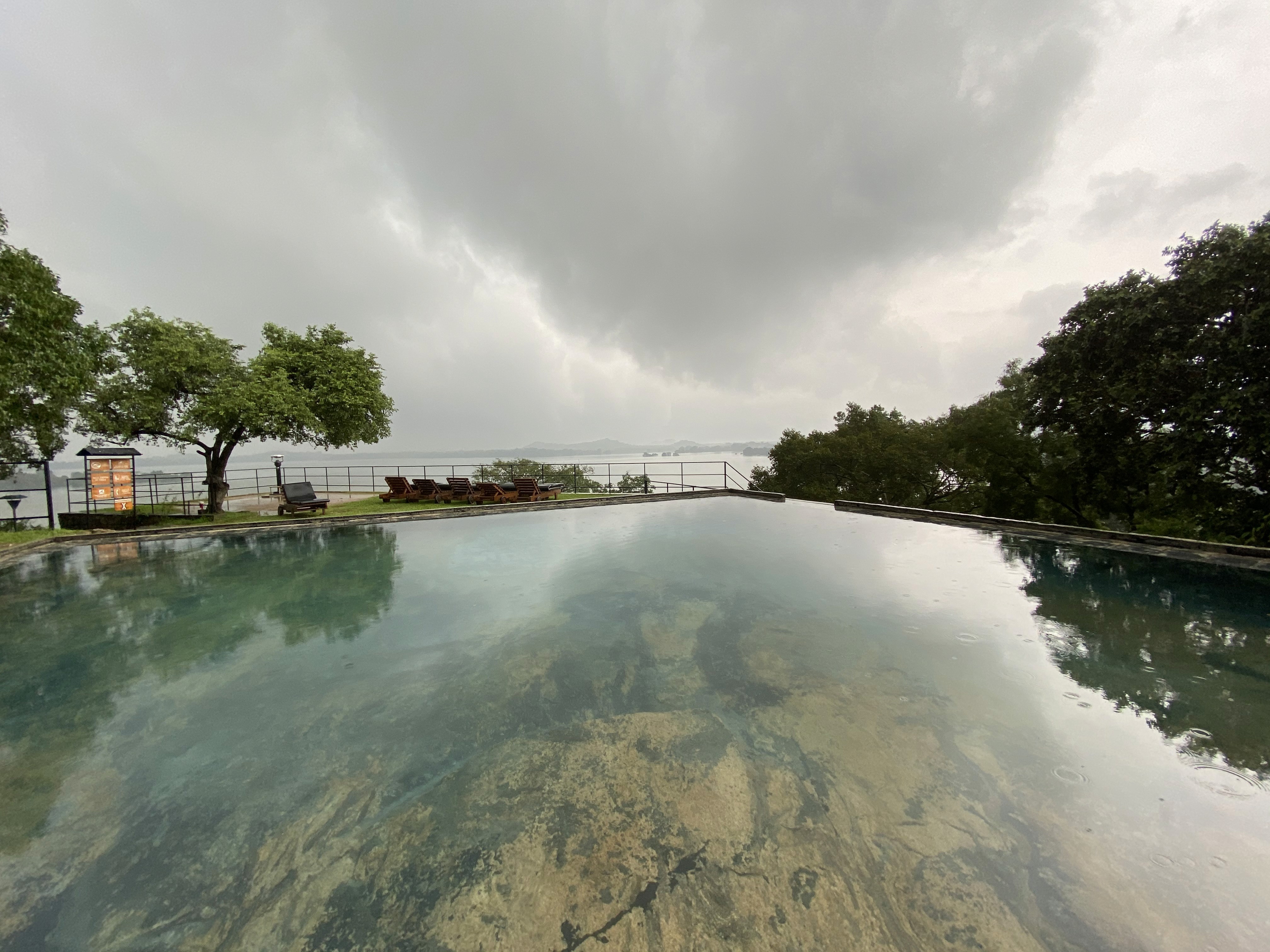
At check-in, I mentioned I was an architect, travelling for Bawa. And they gave me the room he used to stay in when he visited his own hotel. I spent two days there watching something I had never seen architecture do: in the morning, the birds flew across the lake in one direction. In the evening, they came back the other way. Elephants come down to the water. And the hotel just sits there, open to the lake, letting the jungle grow over it.
Ahungalla is one moment, one peak. Kandalama is the opposite lesson: a sequence. Every hour, the place reveals one more thing and every reveal becomes an anchor in your memory. A hotel that shows you everything in the first ten minutes gives you one memory. A hotel that unfolds gives you a new one every day.
And notice what Kandalama never needed: spectacle. The building gives more back to that landscape than it took -> the vegetation, the wildlife corridor, the water. Thirty years ago, nobody called that regenerative development. Bawa just called it good manners toward a place.
That's the second decision: don't design a building. Design the sequence in which a place reveals itself.
3. Give the Memory a Story
Capella Ubud, Bali - Bill Bensley
Everything so far is about designing the experience. But Bawa left one question unanswered, and it's the question a developer has to ask before any of this: who is the guest, and why should they come at all?
Sixty minutes from my place in Bali stands the clearest answer I know.

Capella Ubud. Twenty-two tents and one lodge in the Keliki Valley. Before Bill Bensley drew a single tent, there was a story: the early European settlers who arrived in the 1800s, and their pioneering spirit. And here's what matters: that story was not a marketing layer added at the end. It was the product decision that shaped everything downstream.
Why tents and not villas, in a market drowning in villas? Because explorers camp. Why a suspension bridge instead of a driveway? Because arrival should feel like an expedition. Why antiques and steamer trunks instead of the usual spa-neutral interiors? Because the story demands it. And when they built it, twenty-two tents on that terraced hillside, not a single tree was cut. The rock was there first at Kandalama. Here, the forest was.
When I visited, here's what struck me most: the story isn't on the walls. It's in the people. Our guide never said "hotel" or „rooms", he said "camp," "tents," "expedition," and told us about the European traders who came here for spices. In the evening, every seat at the campfire was taken, guests grilling marshmallows while a silent film flickered in the background: Charlie Chaplin's own footage of Bali, from the 1930s.
Then the chef stepped to the fire. He explained that Api Jiwa, the name of the restaurant, is Sanskrit: fire of the soul. Fire brings warmth, he said. Fire brings life. Fire brings flavour. And then he said one sentence I couldn't have scripted better: "I hope you are ready for some food and flavour, to remember this evening."
A chef, at a fire, in the jungle, selling a memory. Not a meal. That's what it looks like when positioning doesn't just design the tents. It scripts the evening. It scripts the people.
Did it work? Travel + Leisure readers named Capella Ubud the best hotel in the world in 2020. In 2024, it was their number one hotel in Indonesia. And in 2026, it ranked number one resort in Indonesia and number five hotel in the world. In a market with more competition per square kilometre than almost anywhere on earth.
That's not a lucky opening season. That is what strong positioning looks like when it keeps its relevance over time, which is exactly what we mean when we say brand equity.
Your guests don't review your hotel. They review their memory of it. Positioning decides what story that memory tells.
Third decision: before you design the building, write the story the guest will tell.
4. Discover the Identity
The Singular Patagonia, Chile - Pedro Kovacic
Now, the developer's chapter. Because there's an obvious objection: Bensley had a blank site and a big imagination. Most sites have constraints.
Good. Here is the most constrained site on this list. Southern Chile, Puerto Bories, the edge of the world. A former industrial cold-storage plant from the early twentieth century, where Patagonia's sheep estancias once froze and shipped their production to Europe. In 1996 it was declared a national monument. Its protected status severely constrained what could be altered. As a developer, this is the site your feasibility study warns you about.
The standard playbook would fight those constraints, hide the industrial past, build a panoramic lodge next door, import an identity.
The Singular did the opposite. The machinery stays. The boilers and the workshops are part of the guest journey. The industrial history isn't the problem the design solves. It is the product. You sleep inside the story of Patagonia's industrial age and then you walk out into the landscape it came from.
And the market's answer? Travel + Leisure, this year: number one resort in South America. Number seven hotel in the world. A converted freezer plant at the end of the world, ranking ahead of many purpose-built luxury resorts around the world.
Here's the lesson for developers. Every site already contains an identity: the landscape, the history, the culture, the reason a building stood there in the first place. Most projects spend millions inventing an identity and importing it. The best projects spend attention discovering the one that's already there. It's an asset already embedded in the site and one competitors cannot easily reproduce. A brand can be imitated. A hundred-year-old freezer plant at the end of the world cannot.
A hotel that could be anywhere is filed by the brain under "anywhere."
Fourth decision: don't invent an identity. Discover it.
5. Design the Departure
Six Senses Vana, India - Esteva i Esteva Arquitectura
One decision left. And it comes straight from the psychology at the beginning: the peak and the end.
Be honest about our industry. We obsess over arrivals. The lobby. The welcome drink. The first impression. We design the first thirty seconds beautifully. And how does a stay end? A queue at checkout. A dispute over the minibar. A taxi. The last memory most hotels design is an invoice.
The peak gets an architect. The end gets a printer.
But the checkout was never the real ending. The real ending is the state you're in when you leave: how you slept on the last night, how you feel in the taxi, what's in your head on the flight home. That's the ending your memory keeps. And most hotels leave it completely to chance.
One hotel designs it more seriously than anyone.
Vana, in the Himalayan foothills of India. Founded in 2014 as an independent retreat, today part of Six Senses. And Vana understands something most hotels don't: transformation takes time. A stay can start at three nights but the retreat encourages you to go deeper. A week. Sometimes three. The product isn't designed around how fast a room can turn over. It's designed around how long meaningful change takes.
And what is the product? Not the room. When you arrive, they provide cotton kurta pajamas to wear throughout the retreat. Your days are built around Ayurveda, movement, sleep, food, silence. Every element answers one question: in what state will this person leave? The whole retreat is built around an ambition: that guests walk out sleeping better, moving better, thinking more clearly. And that change becomes part of what they take home.
What if the real product isn't the room but the state in which the guest leaves?
This isn't only for destination spas. Every hotel can answer that question, at every scale: in what state does the guest leave? But the question has to come before the amenity list. Adding yoga, a sauna and a cold plunge is not a transformation strategy. It's a shopping list. The strategy is deciding what change you're designing for and having the discipline to build only what serves it. Sometimes what serves it is stillness.
Fifth decision: design the departure. It's the last thing you build and the first thing they remember.
Memory Is the Asset
So, back to the question we started with. Why do we remember some hotels for the rest of our lives and forget others the moment we check out?
Because the hotels we never forget were designed backwards. From the memory. Someone decided what the peak would be, before the floor plan. Someone designed the place as a sequence that keeps revealing itself. Someone wrote the story the guest would tell, before the first drawing. Someone found the identity the site already had, instead of importing one. And someone designed the state in which the guest walks out the door.
Peak. Sequence. Story. Place. Departure. Five decisions. None of them starts with architecture, and architecture makes every one of them real.
That's the work I love: not choosing between the architect, the developer and the hotelier, but holding all three perspectives in the same decision.
Psychology gives us a useful distinction: the experiencing self and the remembering self. And here is the commercial truth hiding in that distinction: the review, the recommendation, the return booking and the willingness to pay are all decisions made by the remembering self.
We build for the experiencing self. Our guests buy with the remembering one.
For developers and investors, the translation is simple. The physical components of a hotel begin ageing from the day it opens. Interiors date. Furniture wears. Buildings require maintenance and reinvestment. There is one asset in hospitality that can appreciate long after the interiors begin to depreciate: the memory of the guest. It compounds. It gets retold. It books the next stay. It builds the brand you couldn't buy.
Memory is the asset. Everything else is maintenance.
The hotels we never forget were not designed around buildings. They were designed around the person who leaves.
Written by Maximilian Seiferlein / Photographs by the author